A History of Capitol Square
The Early Grounds (1780s–1840s)
When the Capitol was completed in 1788, the grounds around it were still open and undefined. In 1816, architect Maximilian Godefroy created the first formal landscape plan for Capitol Square, introducing a French-style design with geometric walkways, fountains, and groves of trees. The grounds became one of the earliest planned urban green spaces in the country. By 1818, a tall ornamental cast-iron fence enclosed the Square, marking it as a civic centerpiece for the city of Richmond.
A New Vision of a Public Park (1850s)
By the mid-19th century, Richmond leaders sought to transform the Square into a more naturalistic park. In the 1850s, architect John Notman redesigned the grounds in the English picturesque style, with curving paths and open lawns. This shift mirrored trends in Europe and America and anticipated the great urban parks to come, predating New York’s Central Park by several years. Capitol Square quickly became a gathering space for both official ceremonies and daily leisure for Richmond’s citizens.
Civil War and Reconstruction (1860s–1870s)
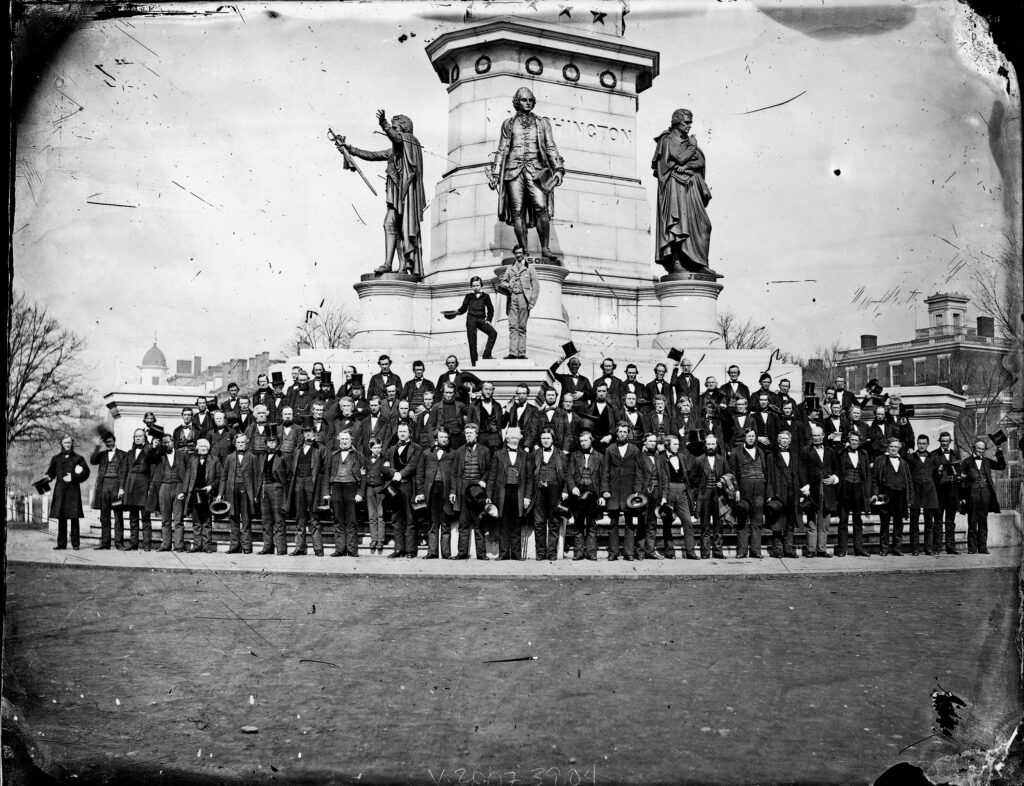
During the Civil War, Capitol Square was at the heart of Confederate Times. The grounds hosted public ceremonies. After the war, the Square became a stage for change. In 1865, a mass Union rally drew thousands, symbolizing the nation’s attempt at reunion. Only a few years later, in 1870, tragedy struck when the overcrowded Court of Appeals chamber collapsed into the House of Delegates chamber below, killing 62 people. This “Capitol Disaster” was one of the most devastating events in the site’s history, and it shaped the use of the Capitol and grounds for decades.
Growth of the Grounds (1880s–1930s)
The late 19th and early 20th centuries brought new monuments and state buildings to Capitol Square. In 1906, major expansions to the Capitol itself redefined the landscape. The Executive Mansion, built in 1813 and still in use, gained a more prominent role as part of the Square’s ensemble of state buildings. Monuments were added to honor Virginia leaders, including generals, governors, and cultural figures, creating a sculptural landscape that blended history with public space.
Civil Rights and Commemoration (1930s–1990s)
Capitol Square continued to evolve alongside Virginia’s political and social changes. As women and African Americans gained a greater role in public life, new memorials were proposed to reflect this broader story of the Commonwealth. By the mid-20th century, the Square became a backdrop for demonstrations, inaugurations, and public rallies, cementing its role as both a civic park and a symbol of democracy.
Modern Era and Renewal (2000s–Present)
At the turn of the 21st century, new memorials transformed Capitol Square into a space that honors Virginia’s diverse past and present. The Virginia Civil Rights Memorial (2008) commemorates the students and attorneys who fought segregation. Mantle (2018), designed by Native artist Alan Michelson, honors Virginia’s indigenous peoples. In 2019, the Voices from the Garden monument was unveiled, celebrating the lives of Virginia women across four centuries.
Today, Capitol Square balances its roles as a working government campus, a historic landmark, and a public park. Its evolving landscape continues to tell the story of Virginia, not only through its monuments to the past but also through its living traditions of civic life, remembrance, and renewal.